
Professor Takeshi Kawano and his research group have advanced their work on “5-µm-diameter silicon microneedle electrodes” and developed a minimally invasive neural electrode device by introducing a flexible substrate (Fig. 1). This approach further reduces damage to brain tissue and enables stable neural recordings from the mouse brain for over 1 year. The group also confirmed that neuronal death is significantly reduced compared with conventional electrodes. In addition, corroborating with Professor Masahiro Ohsawa at Teikyo University, they successfully developed “parylene microneedle electrode”, in which the needle portion is made flexible, demonstrating even more minimally invasive and recovery of neural signal quality during electrode implantation (Fig. 2).
These technologies preserve native tissue and neuronal networks and provide a promising platform for future neural interface applications.
Funding agency:
This work was supported by the Japan Society for the Promotion of Science (JSPS)Grants-in-Aid for Scientific Research (KAKENHI) Grant Numbers 17H03250, (TK),20H00244 (T.K.), 24H00315 (T.K.), 19KK0365 (T.K.), 15H05917 (K. K.), 24K15724
(R.N.), 25K22680 (R.N.), 20H00614 (R.N. and K.K.), 16H05460 (M.O.), 17KK0172(M.O.), 22K18650 (M.O.), and 24K02786 (M.O.), the Adaptable and Seamless Technology transfer Program through Target-driven R&D (A-STEP) from the Japan
Science and Technology Agency (JST) Grant Number JPMJTR23RK (T.K.), and the Japan Agency for Medical Research and Development (AMED) Grant Number JP24ym0126814 (T.K.). T.K. was supported by the Nagai Foundation for Science &
Technology and the Gendered Innovation Research Grant from Toyohashi University of Technology. R.N. was supported by the Takeda Science Foundation and the Hibi Science Foundation. R.N., T.K., and K.K. were supported by the IRES 2 Open Innovation Project. H.S. was supported by JST, the establishment of university fellowships toward the creation of science technology innovation, Grant Number JPMJF2121.
Bibliographic Information:
[1] Hinata Sasaki, Koji Yamashita, Sayaki Shimizu, Kensei Sakamoto, Rika Numano, Kowa Koida, Takeshi Kawano, “A flexible‐substrate 5‐µm‐diameter needle electrode: minimizing neuronal death and enabling year‐long neural recording”, Advanced Materials Interfaces, Volume 12, Issue 11, 2400974, June 9, 2025.
DOI: https://doi.org/10.1002/admi.202400974
[2] Hinata Sasaki, Sayaki Shimizu, Rexy Alvian Nerchan, Koji Yamashita, Naohiro Takahashi, Rina Chinone, Yurika Kurashige, Rika Numano, Kowa Koida, Masahiro Ohsawa, Takeshi Kawano, “A self-insertable 5-µm-diameter flexible microneedle for minimally invasive and stable in vivo neural recording”, Sensing and Bio-Sensing Research, Volume 50, 100915, December, 2025.
DOI: https://doi.org/10.1016/j.sbsr.2025.100915
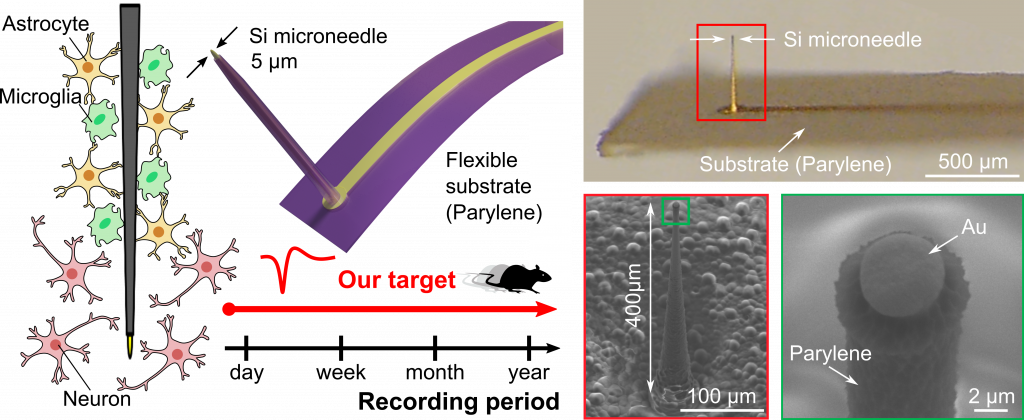
Fig. 1 A 5-µm-diameter silicon microneedle electrode device. The microneedle electrode integrated on a flexible substrate minimize damage to brain tissue and enable long-term neural recording exceeding one year.
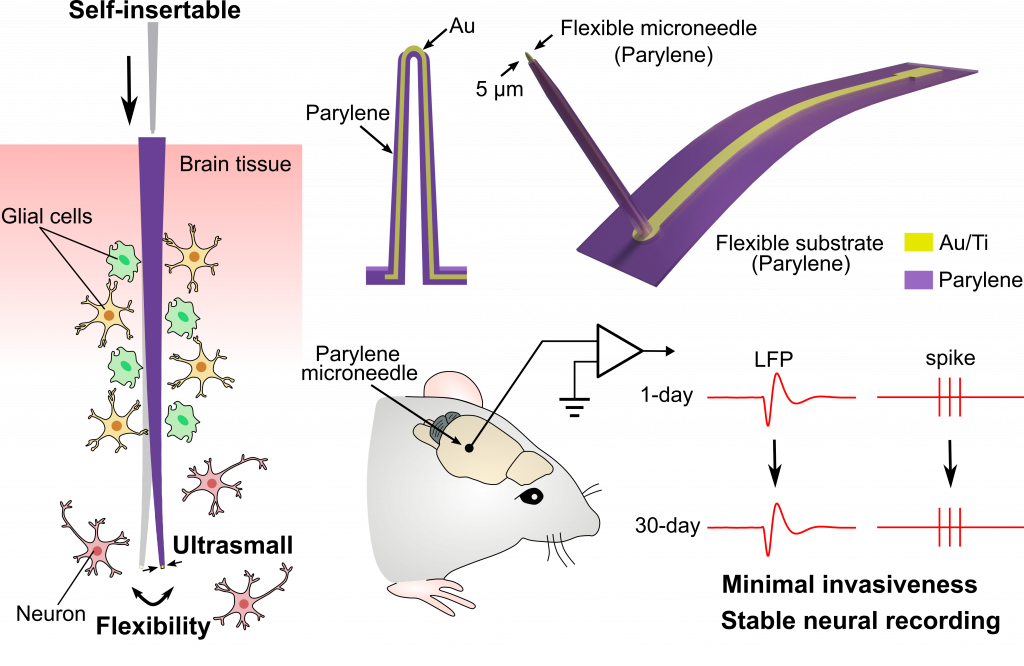
Fig. 2 A fully parylene microneedle electrode device. By removing the silicon core inside the microneedle, a flexible parylene microneedle electrode device was developed. Compared with the silicon-based microneedle electrode (Fig. 1), this parylene device enables further reduced invasiveness and more stable in vivo neural recording.