
マイクロ流体チップテクノロジーを応用し、食中毒病原体の多検体・多項目の遺伝子検査を実現 ~遠心送液型デバイスによる簡便・迅速・低コストな現場即時検査の道を拓く~
A research team led by Professor Takayuki Shibata (Department of Mechanical Engineering, Actuation and Sensing Devices group, Institute for Research on Next-generation Semiconductor and Sensing Science) at Toyohashi University of Technology, together with Associate Professor Masashi Kitamura of Josai University and Professor Yusuke Yamauchi of Nagoya University, has developed a centrifugal microfluidic device for multiplexed genetic detection by applying microfluidic chip technology.
Conventional centrifugal microfluidic devices perform metering and dispensing operations by controlling the rotational speed. In this study, the research team established a sequential liquid dispensing theory that enables metering and dispensing operations to be performed simultaneously at a constant rotational speed, and clarified the design guidelines for the device. This technology is expected to simplify the equipment and reduce costs, contributing to the practical implementation of rapid on-site testing.
The team also developed a microfluidic device capable of simultaneously performing genetic tests on four samples and five targets. The usefulness of the device was demonstrated through the simultaneous detection of multiple foodborne pathogens—Salmonella, Vibrio parahaemolyticus, Campylobacter, and norovirus—using a colorimetric loop-mediated isothermal amplification (LAMP) method.
This testing technology is highly versatile and can be applied not only to foodborne pathogens, but also to the detection of food allergens and genetic testing for viruses that infect humans and crops.
The research team is currently working toward the practical implementation of this technology in society. The technology aims to help protect people’s lives and health from viral infectious diseases, ensure food safety and hygiene against food allergens and foodborne bacteria, and contribute to a stable food supply by preventing crop diseases.
Publication Information
Daigo Natsuhara, Yuka Kiba, Ryogo Saito, Shunya Okamoto, Moeto Nagai, Yusuke Yamauchi, Masashi Kitamura, Takayuki Shibata,
“A sequential liquid dispensing method in a centrifugal microfluidic device operating at a constant rotational speed for the multiplexed genetic detection of foodborne pathogens,”
RSC Advances, 14, 31 (2024), 22606–22617.
DOI: https://doi.org/10.1039/D4RA04055D
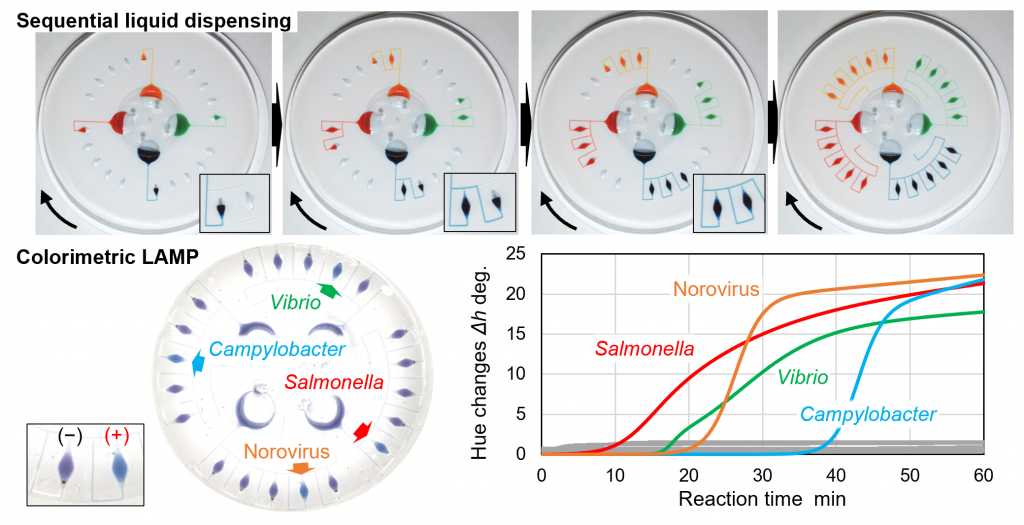
Figure. Photograph of the centrifugal microfluidic device for multiplexed genetic testing (top: simultaneous delivery of four types of liquids by centrifugal force and their metering and dispensing into five reaction chambers) and results of simultaneous testing of four samples for four foodborne pathogens—Salmonella, Vibrio parahaemolyticus, Campylobacter, and norovirus—using a colorimetric loop-mediated isothermal amplification (LAMP) method (bottom left: device after the genetic amplification reaction; the color of the reaction chambers changes from purple (negative) to light blue (positive) depending on the sample type; bottom right: genetic amplification curves obtained using an image-based color analysis system developed by the research team).
